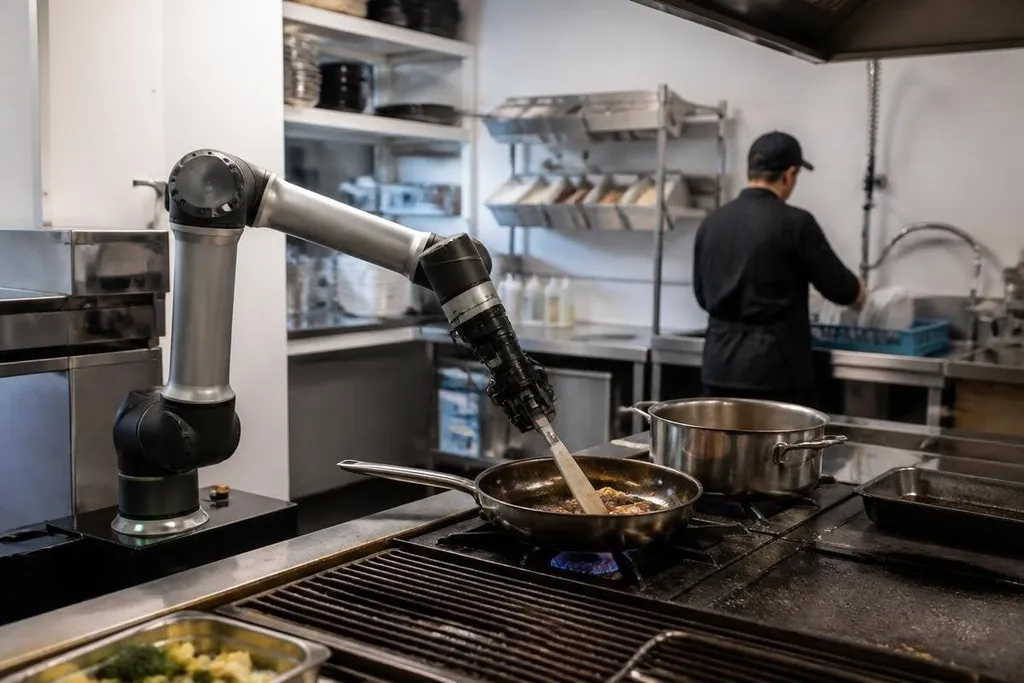
Cooking robots are being built around specific kitchen jobs, such as stirring, dispensing ingredients, moving pans, or loading a dishwasher. Their value depends on how well they handle messy food, changing layouts, and tasks that people perform without thinking.
- The useful part: robots repeat set motions without tiring.
- The hard part: food changes shape, weight, and texture during cooking.
- The buyer’s test: check the task, cleaning work, and human input needed.
A kitchen is a difficult robot workspace
A factory robot usually works with fixed parts in known positions.
A kitchen changes between meals, and the same ingredient may arrive as a full onion, chopped pieces, or a sticky paste.
That variation affects every part of the robot. Cameras can help locate a bowl or pan, while force sensors can detect contact with a surface. Motors then move an arm or gripper through a planned path.
The robot still needs a clear task. “Cook dinner” is too broad for a reliable system. “Move a bowl to the mixer, add a measured ingredient, and stir for a set time” gives the software a sequence it can check.
This is why many cooking robots focus on one stage of food preparation. A fixed dispenser can handle measured liquids. A robot arm can repeat a stirring motion. A machine with a heated surface can control temperature while a separate tool handles the pan.
Repetition is where robots help
Repeated kitchen work takes time because it has to happen for every dish. Robots can repeat the same motion while a person handles seasoning, checks texture, or makes a choice the software cannot judge well.
The benefit also depends on placement. If the robot reaches a cooker but cannot access the refrigerator, a person still has to move ingredients. A system that needs a worker to load every tool may shift work rather than remove it.
Cleaning matters just as much as motion. Food residue can collect around joints, grippers, seals, and tool mounts. Any kitchen system needs surfaces that can be washed, parts that can be removed, and a safe way to handle heat and spills.
For a restaurant, the question is tied to service flow. A robot may repeat a preparation step during busy periods, but staff still need to refill ingredients, clear finished food, and respond when an item moves outside its expected position.
A full dinner service tests a cooking robot in ways one plated dish cannot. Ingredient refills, dirty tools, timing changes, and staff handoffs all arrive together. Robot24.com's cooking robotics reporting can trace those tests to a named machine, kitchen, date, and result before the difficult cases begin.
What remains difficult
Food is soft, wet, and easy to damage. A gripper that holds a metal tray may crush a ripe tomato. A spoon that works with soup may struggle with dough. The robot needs a different tool, motion, or control setting for each case.
Heat adds another risk. A robot must keep its arm, cables, sensors, and control box away from hot surfaces and steam. It also needs a safe response if a pan shifts, a tool jams, or a person reaches into the work area.
Human supervision remains part of many systems. A person may need to place ingredients in known spots, start a recipe, remove a finished pan, or correct an error. That can still save work, but it changes the cost and layout of the kitchen.
The open question is repeatability outside a controlled setup. A demo can show one recipe with prepared ingredients. A working kitchen must handle substitutions, spills, missing items, different containers, and staff moving nearby.
A buying checklist for kitchen automation
Use these checks before you compare robot arms or complete cooking systems:
- Name one task: choose the step that repeats often enough to justify a machine.
- Check human input: write down every loading, refill, reset, and handoff.
- Inspect food contact parts: confirm how tools come off, wash, and dry.
- Test the failure case: ask what happens when a bowl moves or an ingredient runs out.
- Measure the space: leave room for people, cleaning, service, and emergency stops.
- Price the full setup: include tools, guards, software, installation, and maintenance.
I’d buy cooking automation for a narrow, repeated job before buying a robot that claims to run the whole kitchen. A system earns its place when it handles that job safely, cleans without special treatment, and keeps working when the recipe meets a real kitchen.
The next useful proof will come from longer kitchen runs, where robots face spills, changing ingredients, and human traffic for more than one prepared demonstration.